The Complete GamersGround Encyclopedia: Every Game, Every Term, Every Price Explained (2026)
By Toishaa Soni · 24 July 2026
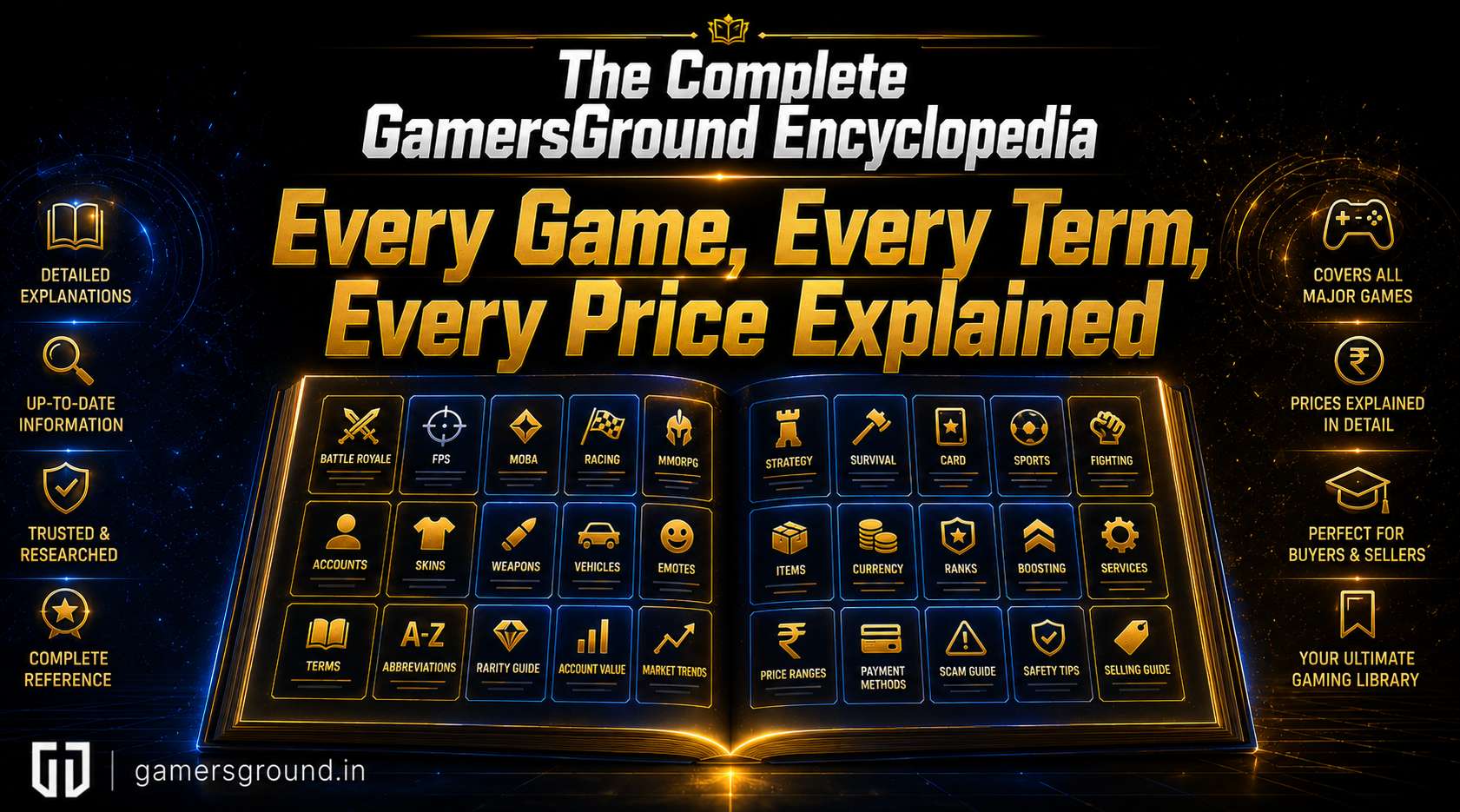
One page covering everything: every game GamersGround supports, every resale term worth knowing, every price range across every rank and skin tier. Bookmark this. It is the reference the rest of the site links back to.
This page exists because the rest of the GamersGround content library, sixty posts and counting, keeps referencing the same terms, the same price logic, and the same core ideas over and over. Rather than making you dig through individual guides every time you need a definition or a quick price check, this is the single reference page that holds all of it.
Bookmark it. Every other guide on this site links back here, and this page links out to the deep-dive guides whenever a topic deserves more than a paragraph.
Part One: How Gaming Account Resale Works in India
Before the glossary and price tables, a quick grounding in the fundamentals for anyone new to this space.
Gaming account resale is the practice of buying and selling ownership of an existing game account rather than starting fresh. In India, this market has grown into a genuine parallel economy running alongside the games themselves, driven by players who want to skip early progression, collectors chasing specific rare content, and sellers looking to convert years of playtime into real money.
The value of any account comes down to a small number of consistent factors across every game: rarity of content, competitive rank or skill history, account age and cleanliness, and how completely the listing communicates all of that to a buyer. Games differ in exactly which signals matter most, which is why this page breaks value logic down separately for each title.
Transactions on GamersGround happen as a classified listing model. The platform connects buyers and sellers directly. Payment happens between the two parties through UPI or bank transfer, and the credential handover happens directly as well. Understanding this structure matters because it shapes how due diligence and trust-building work throughout the entire process.
Part Two: The Glossary
Account age refers to how long an account has existed since creation, generally used as a trust and depth signal rather than a direct price driver on its own.
Ban risk describes the possibility that an account gets suspended or permanently banned, either from prior cheat software use, suspicious login patterns, or violations committed after purchase. Covered in full in Can You Get Banned for Buying a Gaming Account.
Booyah Pass is Free Fire's seasonal reward system, similar in structure to a battle pass, that produces exclusive cosmetic rewards tied to specific seasons.
Buyer pool refers to the total number of active buyers shopping for accounts in a specific game at any given time. Larger buyer pools generally mean faster sales.
Capital lockup is a reseller term describing money tied up in a purchased account that has not yet resold, restricting the reseller's ability to make further purchases.
Collector skin is MLBB's highest cosmetic tier, featuring unique animations, voice lines, and effects that set it apart from lower-tier skins.
Conqueror is BGMI's top rank tier, held by a very small percentage of the active player base in any given season.
Diamond balance refers to unused in-game currency sitting in an account, which functions as immediately usable value for a buyer upon transfer.
Emblem in MLBB is a customisable stat-boosting system tied to hero roles, and its development level is checked by competitive buyers alongside hero count.
Escrow describes a payment-holding mechanism where a neutral third party holds funds until both sides of a transaction confirm completion. Not a feature of classified platforms like GamersGround, where payment happens directly between parties.
Flipping is the practice of buying an account specifically to resell it for profit, often with minimal personal use of the account itself. Covered in full in How to Flip Gaming Accounts for Profit in India.
Frozen Arrow is a Valorant Archer equipment style reference used loosely by the community; more precisely this describes limited weapon skin effects tied to specific bundles rather than a formal game term.
Ghost account refers to an inactive or abandoned account with minimal recent activity, generally lower in resale value regardless of historical content.
Glacier M416 is one of the most recognised and searched gun skins in BGMI, historically one of the strongest single value drivers in any BGMI listing.
Hero Equipment is Clash of Clans' TH16-era gear system for heroes, directly affecting combat performance and increasingly checked by resale buyers alongside hero levels. Covered in full in CoC TH16 Hero Equipment Guide.
King Tower Level (KT) is Clash Royale's core progression metric, used alongside card levels to evaluate account strength.
Knife skin in Valorant refers to melee weapon cosmetics, consistently the single highest-value individual asset category in Valorant account resale.
Legacy decoration refers to Clash of Clans cosmetic base decorations from past seasonal or holiday events that have not been reissued, considered genuinely irreplaceable content.
Limited skin describes any cosmetic item tied to an event or time window that has since closed without being made available again.
Mythic Glory / Mythical Glory is MLBB's highest rank tier, held by a small fraction of the active competitive player base.
Mythic outfit in BGMI refers to the game's top cosmetic tier, typically tied to anniversary events or special Royale Pass cycles.
OB update refers to Free Fire's numbered content update cycle, used as a reference point for dating specific cosmetic content and its rarity.
Presumptive taxation (Section 44AD) is an Indian tax provision allowing eligible businesses to declare a flat percentage of turnover as profit without maintaining full accounts. Relevant to active resellers. Covered in full in Gaming Account Reselling Income Tax in India.
Radiant is Valorant's top rank tier.
Radianite is Valorant's weapon skin upgrade currency, used to level up premium skins and unlock additional visual and audio effects.
Rank history refers to an account's peak competitive rank across multiple seasons, used by buyers as the primary indicator of consistent skill.
Reputation score is GamersGround's seller trust rating, built from completed transactions and buyer reviews. Covered in full in GamersGround Seller Reputation Score Explained.
Scarcity describes the core economic principle driving most resale premiums: content that cannot be obtained through any current spending route commands the highest prices across every game covered on this site.
Starlight Pass is MLBB's premium subscription cosmetic system, producing exclusive skins tied to specific months that are not reissued.
Tier list (resale context) refers to a ranking of specific in-game items by their actual resale value and buyer demand, distinct from a gameplay power ranking.
Transfer describes the process of moving full account ownership, including credentials and linked accounts, from seller to buyer.
Vanguard is Riot Games' kernel-level anti-cheat system used in Valorant, notable for its aggressive and hardware-level ban capability.
Part Three: Price Reference by Game
Quick-reference price ranges pulled from across the GamersGround guide library. For full context on any of these, follow the linked deep-dive guide.
BGMI: Base Ace accounts with no notable skins start around Rs.1,500. Accounts with a single S-tier skin like the Glacier M416 or a Mythic outfit typically range Rs.6,000 to Rs.14,000. Multi-season Conqueror accounts with strong skin collections reach Rs.20,000 to Rs.40,000, with elite collector accounts going well beyond that. Full detail in BGMI Ace vs Conqueror Price Difference and BGMI Skin Rarity Tier List.
Free Fire: Standard accounts without notable OB-era content range Rs.500 to Rs.2,000. Accounts with verified early OB skins or collaboration content reach Rs.12,000 to Rs.35,000 and above. Guild accounts follow a separate pricing logic based on active membership, typically Rs.1,500 to Rs.20,000 depending on scale. Full detail in Free Fire OB Skin Checker and Free Fire Guild Account Price Guide.
Clash of Clans: TH15 accounts typically range Rs.3,000 to Rs.12,000. TH16 accounts with developed Hero Equipment reach Rs.9,000 to Rs.28,000, with elite equipped accounts going higher. Full detail in CoC TH16 vs TH15 Price Difference and CoC TH16 Hero Equipment Guide.
Valorant: Mid-range accounts with one or two premium bundle skins range Rs.5,000 to Rs.12,000. Accounts with a knife skin or Radiant history reach Rs.18,000 to Rs.45,000. Full detail in Valorant Skin Tier List for Resale.
Mobile Legends Bang Bang: Accounts below Mythic rank with limited skin content range Rs.2,000 to Rs.4,000. Mythic-and-above accounts with Collector or Limited skins reach Rs.7,000 to Rs.25,000, with multi-season Mythical Glory collector accounts going beyond that. Full detail in MLBB Account Checker: What Makes an Account Worth Rs.5,000+.
Clash Royale: Accounts with consistent season pass history and King Tower 13 to 14 range Rs.3,500 to Rs.8,000. Multi-year Diamond Pass accounts with limited tower skins reach Rs.14,000 and above. Full detail in Clash Royale Season Pass and Resale Value.
Part Four: Selling Fundamentals in One Place
Every listing guide on this site circles back to the same core principles. Consolidated here.
Titles should lead with the single most specific, searchable asset. Not "good account for sale," but the actual skin name, rank tier, and level. Full detail in How to Write a Viral Gaming Account Listing.
Screenshots should cover inventory overview, individual premium items, rank history, and progression, in that order. Seven to twelve clean, full-brightness images cover most listings completely.
Pricing should be based on comparable active listings, not on purchase cost or emotional attachment. Check current listings for your rank and skin tier before setting a number.
Descriptions should name every notable asset specifically, with permanence and rarity status stated clearly. Vague claims slow down sales and invite lowball offers.
Transfers should happen in one continuous session, with the seller never logging back in after handover. This single habit protects both the sale and the seller's reputation score.
Part Five: Buying Fundamentals in One Place
For buyers navigating the marketplace, the recurring guidance across every guide on this site comes down to a few consistent checks.
Ask sellers directly whether any third-party software was ever used on the account. Confirm full credential transferability, including email and any linked phone number, before paying. Check the seller's reputation score and completed transaction history before committing to a higher-value purchase. Compare the asking price against several comparable active listings rather than accepting the first number offered. Full detail in Can You Get Banned for Buying a Gaming Account.
Part Six: The Tax and Legal Basics
Income from gaming account sales in India is taxable under the general income tax framework. Casual, one-time sellers generally declare this as income from other sources under Section 56. Regular resellers earning meaningful income are more accurately categorised under business income, with different ITR filing requirements. GST registration becomes mandatory once annual turnover from reselling activity crosses Rs.20 lakh. Full detail in Gaming Account Reselling Income Tax in India.
Part Seven: For Resellers Building a Side Hustle
Reselling as a structured activity, rather than a one-time personal sale, follows its own playbook: choosing a game niche, learning accurate account evaluation, sourcing underpriced accounts, presenting them well, and managing the risks specific to buying and reselling repeatedly. Full detail in How to Build a Gaming Account Reselling Side Hustle and How to Flip Gaming Accounts for Profit.
Where to Go From Here
This page is the map. Every term, every price range, and every core principle referenced across the GamersGround content library sits here in one place, with links out to the full guide whenever you need the complete picture on a specific topic.
List your account free on GamersGround whenever you are ready, armed with an accurate understanding of what it is actually worth.
Browse current listings across every game GamersGround supports to see the market in action before you buy or sell.
Common Questions
Is this page updated as new guides are published?
This encyclopedia is designed as the central reference point for the GamersGround content library and reflects the terms, price ranges, and principles covered across the site as of publication. Price ranges shift over time as game updates and market conditions change, so always cross-check current active listings for the most accurate, real-time pricing.
I am new to gaming account resale entirely. Where should I start?
Start with Part One for the fundamentals, then jump to the specific game section in Part Three that matches your account. From there, follow the linked deep-dive guide for your game to understand exactly what drives value for your specific content.
Does GamersGround support games not listed on this page?
The games covered in detail here, BGMI, Free Fire, Clash of Clans, Valorant, Mobile Legends Bang Bang, and Clash Royale, represent the primary titles covered across the GamersGround content library. Check current platform listings for the full range of supported games.
How is this different from the individual guides already on the site?
The individual guides go deep on a single topic, a single game's skin tiers, a single comparison, a single strategy. This page is the connective layer that ties every term and price point across all of them into one searchable reference, so you do not need to remember which specific guide covered which specific detail.
Can I suggest a term or topic that should be added to this encyclopedia?
The GamersGround content library grows continuously as new games, terms, and market patterns emerge. Feedback and suggestions from the community directly shape what gets covered next.