How to Build a Gaming Account Reselling Side Hustle in India: A Step-by-Step Playbook
By Toishaa Soni · 14 July 2026
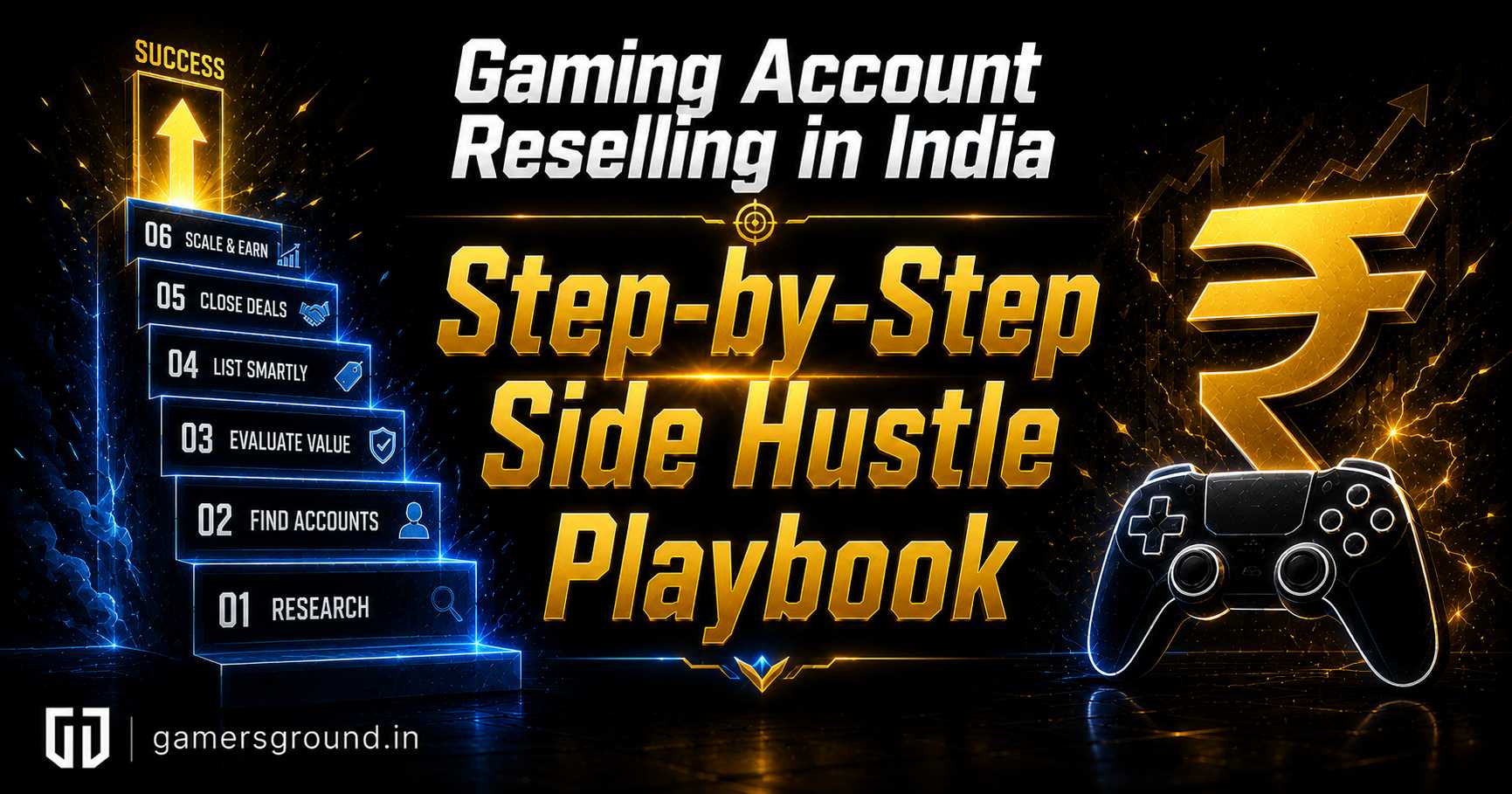
Gaming account reselling is one of the few side hustles in India where knowing the game is your actual edge. This step-by-step playbook covers how to source accounts, price them correctly, sell faster, and scale from your first flip to a consistent monthly income.
Most side hustles in India ask you to learn something new from scratch. Drop shipping means learning logistics. Stock trading means learning markets. Freelancing means building a skill set that takes months to develop before the first rupee comes in.
Gaming account reselling is different. If you already play seriously, you already have the core asset the entire business runs on: the ability to evaluate an account accurately.
You know what a Conqueror badge actually means. You can look at a BGMI skin list and identify the Glacier M416 immediately. You understand that a CoC base with maxed heroes and a decade of war history is worth something completely different from a TH14 with rushed defenses. That knowledge, which you built just by playing, is the moat that separates you from someone who watched a YouTube video about reselling and tried to jump in without it.
This playbook is built for Indian gamers who want to turn that edge into consistent monthly income. It covers sourcing accounts, evaluating them accurately, pricing them for the Indian market, selling faster, managing risk, and scaling the operation once the early flips are working.
GamersGround is the platform where Indian buyers and sellers connect for account transactions across BGMI, Free Fire, Clash of Clans, Valorant, MLBB, and more. Keep it open as you read.
Why Gaming Account Reselling Works in India Right Now
The Indian gaming market has grown faster than almost any other digital economy in the country over the last five years. Hundreds of millions of people play mobile games. A meaningful percentage of them spend real money on in-game content. And a growing number of them want to buy an established account rather than grind for months to reach a level where the game becomes genuinely enjoyable.
That demand is real and it is currently underserved. The supply of well-presented, accurately priced accounts is significantly lower than the pool of buyers actively searching for them. Most sellers list accounts poorly, price them wrong, or give up after a week without a sale. Buyers end up settling for the best available option rather than the account they actually wanted.
That gap is where the reselling opportunity lives.
A reseller who knows how to source undervalued accounts, present them well, and price them at market rate is filling a gap that the casual seller market consistently leaves open. The margin in this business comes from doing the basics better than the average seller, not from some complicated edge.
Step 1: Choose Your Game Niche
Trying to resell across every game simultaneously when you are starting out is the fastest way to make expensive mistakes. Every game has its own skin hierarchy, its own rank system, its own buyer profile, and its own price range. The learning curve for evaluating accounts accurately in one game is steep enough. Spreading that across five games before you have closed your first ten deals will cost you money.
Pick one game to start. Ideally the game you know best as a player. The games with the strongest resale markets in India right now are BGMI, Free Fire, Clash of Clans, Valorant, and Mobile Legends Bang Bang. Each has a different profile.
BGMI has the largest buyer pool and the fastest sale cycles for well-priced accounts. Skin rarity is the primary value driver and knowing the BGMI cosmetic hierarchy is essential before your first purchase.
Free Fire has a deep market in Tier 2 and Tier 3 cities and a passionate community around OB-era content. Accounts with early OB skins are undervalued by sellers who do not know their own inventory.
Clash of Clans rewards resellers with patience. The value drivers are Town Hall level, hero development, and legacy content. Good CoC accounts take longer to sell but close at higher margins than most mobile game accounts.
Valorant has the most sophisticated buyer pool. Buyers know exactly what they want and they know whether a price is fair. Margins are strong on accounts with premium knife skins but evaluation accuracy is non-negotiable.
MLBB is the most underexplored opportunity in this list. The Indian MLBB resale market is less mature than BGMI or CoC, which means more underpriced supply and less competition among resellers.
Start with one. Add a second game after your first ten successful flips. Add more only when your evaluation ability and your working capital can handle the additional complexity.
Step 2: Learn to Evaluate Accounts Accurately
This is the skill the entire business depends on. Buying an account for Rs.4,000 that you believe is worth Rs.8,000 is the job. Buying an account for Rs.4,000 that turns out to be worth Rs.3,500 is how the business loses money.
Accurate evaluation means knowing the difference between those two accounts before you pay.
For every game you resell, build a reference document that covers the following.
Skin tier hierarchy: which skins are S-tier, A-tier, B-tier in the resale market for this game. Not in terms of game quality but in terms of what buyers search for and pay premiums for. For BGMI this means knowing Glacier M416 from Legendary AKM. For Valorant it means knowing Elderflame from Celestial. For CoC it means knowing what legacy decorations are and how to identify them.
Rank value: what each rank tier is worth to a buyer in this game. An Ace account in BGMI, a Mythical Glory account in MLBB, a Conqueror in BGMI: each of these sits at a different point in the buyer value curve.
Account age signals: how to read an account's age from the content it holds. This comes with experience but the starting point is knowing which skins, rewards, or items are from which era of the game.
Current buyer demand: what buyers in India are actively searching for right now. This changes with game updates, meta shifts, and seasonal patterns. The fastest way to track it is to spend thirty minutes a week browsing active listings on GamersGround and noting which accounts generate enquiries and which sit.
Build this reference document for your chosen game before you buy your first account. Update it every time a major game update drops or a new skin cycle launches.
Step 3: Find Undervalued Accounts to Buy
The supply side of this business comes from sellers who do not know what they have, do not know how to present it, or need to sell quickly for non-market reasons.
Where to find them:
GamersGround listings are the primary source. Browse the buy section for your game regularly. Look for accounts that are priced below what your evaluation tells you they are worth. Accounts that have been listed for more than two weeks without a sale are often underpriced but poorly presented, or correctly priced for a patient buyer you can be.
Gaming WhatsApp groups and Telegram channels are where many casual sellers post before going to a formal platform. Sellers in these channels are often less sophisticated about pricing and more motivated by quick cash than maximum value. Being active in three to five relevant gaming community groups is a constant source of supply.
Direct sourcing from players you know through gaming communities. Someone who has quit a game is often willing to sell their account for significantly below market if approached at the right moment. Being known in gaming communities as someone who buys accounts fairly and pays immediately builds a reputation that brings sellers to you rather than you hunting for them.
When evaluating a potential purchase, run through your reference document systematically. Do not negotiate or make an offer until you have completed the evaluation. Rushing a purchase because a deal looks good at first glance is how avoidable mistakes happen.
Step 4: Price for the Indian Market
Pricing is where most resellers lose margin even when they buy correctly. There are two failure modes.
Overpricing because of emotional attachment to the purchase cost. Once you have paid Rs.4,000 for an account, the psychological pressure to price it at Rs.9,000 to ensure a comfortable margin is strong. But the market does not care what you paid. It cares what comparable accounts are selling for right now. If the market says Rs.6,500 for this profile of account, pricing at Rs.9,000 means it sits unsold and your capital is tied up.
Underpricing to move quickly. Selling an account for Rs.5,000 that the market would pay Rs.7,500 for given proper presentation is not a success. It is lost margin. The urge to price low to guarantee a sale often comes from lack of confidence in the listing quality rather than an accurate read of buyer demand.
The right price is set by three inputs. First, browse comparable active listings on GamersGround for accounts with similar rank, skin tier, and game. Second, note the asking price of accounts that show signs of buyer interest. Third, position your account at the lower end of the range for accounts above your quality, not at the higher end of the range for accounts below it.
For Indian buyers, specific local price signals matter. Listing a price in rupees explicitly, giving a round-number price, and stating clearly that it is a fixed price or open to reasonable offers all reduce buyer friction. Vague pricing invites lowball offers. Clear pricing attracts buyers who are ready to close.
Step 5: Present the Account Better Than the Competition
This is the highest-return action in the entire reselling process and it costs nothing except time. A well-presented account at accurate market price will outsell a comparable account with a vague listing at a lower price almost every time.
A complete listing for a resold account includes:
A title that leads with the single most searchable asset. Not "good account for sale." Glacier M416, Conqueror Season 8, Mythic outfit, Level 72. The buyer is searching for something specific. Your title needs to match that search before they ever read the description.
Seven to twelve screenshots taken at full brightness in clean interface screens. One overview of the inventory or locker. Individual screenshots of every S-tier and A-tier asset. A screenshot of rank history showing peak ranks by season. A progression or level screen. These screenshots answer every question a buyer has before they ask it.
A description that lists assets specifically with no vague language. No "many rare skins." List every notable skin by name. State which are permanent. State the rank history with season numbers. Confirm the transfer process including whether the email is transferable. State the price clearly with your position on negotiation.
One platform-specific tip for GamersGround: the first image in your listing is the thumbnail buyers see in browse mode. Make it your best individual screenshot, not the locker overview. The overview works better as the second or third image once a buyer has clicked through.
Step 6: Handle the Transfer Cleanly
A clean transfer is what separates a reseller with a good reputation from one who burns buyers and destroys their ability to source future deals.
Before handover: confirm the buyer is satisfied with the screenshots and description. Agree on the price and the transfer process in writing within the chat. Clarify which credentials are being transferred and in what order.
During handover: transfer email access first if the game requires it. Change in-game credentials with the buyer present in the chat. Confirm the buyer has logged in successfully before ending the conversation.
After handover: do not log back into the account under any circumstances. This is the most common source of buyer disputes and the fastest way to lose your reputation as a reseller. The sale is complete at handover. The account is no longer yours.
For high-value transactions above Rs.10,000, requesting partial payment before the transfer process begins and the balance on successful login is a reasonable and commonly accepted structure. Most serious buyers on established platforms understand this.
Step 7: Build Repeat Deal Flow
The difference between someone who did a few flips and a genuine reselling operation is repeat deal flow. One-off deals require you to find new supply and new buyers every time. A system produces deals consistently.
On the supply side, repeat deal flow comes from reputation in gaming communities. Sellers who had a good experience transacting with you refer other sellers. Being known as a buyer who pays fairly, pays immediately, and does not waste sellers' time with endless negotiation is a competitive advantage that compounds over time.
On the buyer side, repeat customers are less common in account reselling than in other businesses because most people buy one account and play it for a long time. What you can build instead is a reputation that makes you the first place buyers look when they are ready. Responding quickly to enquiries, answering questions honestly, and not overpromising account quality are the behaviours that generate referrals and positive community reputation.
Track every deal in a simple spreadsheet. Source, purchase price, sale price, days to sell, game, account profile. After twenty deals, this data will show you which game, which account tier, and which price range is producing your best margins and fastest sales. Double down on what the data shows rather than following intuition.
Step 8: Manage Risk
Every reselling business has risk. In gaming account reselling the specific risks are:
Buying an account with hidden ban history. The account was previously flagged for cheat use and carries a delayed ban that triggers after you have already bought it. Mitigation: always ask sellers explicitly whether any third-party software was ever used. For high-value accounts, ask for screenshots of the account's support history or ban record screens where visible.
Sellers accessing the account after the sale. A dishonest seller retains credentials and logs back in after you have paid, either locking you out or getting the account flagged for suspicious access. Mitigation: change all credentials immediately upon handover and confirm you have control of the linked email before transferring final payment.
Buying into a game meta that shifts. An account with a specific hero or card set that was high-value before a game update can drop in buyer demand after one. Mitigation: do not hold purchased accounts too long. The market for any specific account profile changes with game updates. Fast sales protect margins better than waiting for a higher price that may not materialise.
Capital concentration. Putting all your working capital into one high-value account is higher risk than spreading it across three to four mid-range accounts. A single deal that stalls ties up your entire operation. Diversify within your capital base.
Working capital limit: never commit more than you can afford to have tied up for three to four weeks. Gaming account reselling is not a high-velocity cash business. Accounts take time to sell at the right price.
What Monthly Income Actually Looks Like
Realistic income projections for Indian gaming account resellers at different stages.
Starting out, first one to three months, two to four deals per month: You are still learning evaluation and building deal flow. Expect margins of Rs.1,000 to Rs.3,000 per deal after accounting for the occasional mistake. Monthly income in this phase is Rs.3,000 to Rs.10,000. The goal here is learning, not income.
Established phase, months four to eight, five to ten deals per month: Your evaluation accuracy has improved, your deal flow is more consistent, and your listing quality is producing faster sales. Margins of Rs.2,000 to Rs.6,000 per deal are realistic. Monthly income of Rs.15,000 to Rs.40,000 is achievable for serious operators at this stage.
Scaled operation, eight months plus, ten to twenty deals per month across two or three games: You have built a reputation on both the supply and buyer side. You know which account profiles move fastest in each game. Monthly income of Rs.40,000 to Rs.1,00,000 is realistic for resellers operating at this level with the right capital base and deal quality.
These are not guaranteed numbers. They reflect what the market produces for resellers who execute the steps in this playbook consistently and who treat this as a real business rather than a casual experiment.
Tax and Legal Considerations
Reselling gaming accounts for regular profit is business income under Indian tax law. Once your annual reselling income crosses Rs.1 lakh, treating it as a structured business activity with proper ITR filing is the correct approach.
Keep records of every transaction. Purchase cost, sale price, date, game, payment method. These records support your cost deductions when calculating taxable profit.
At Rs.20 lakh in annual turnover, GST registration becomes mandatory. Build awareness of this threshold before you approach it.
For a detailed breakdown of the tax treatment for gaming account resellers in India, read the dedicated GamersGround guide on income tax and gaming account reselling which covers casual sellers, active resellers, ITR filing, and GST obligations in full.
Starting Today
The playbook is straightforward. The execution is where most people stall because starting feels risky before the first deal proves the model works.
The lowest-risk way to start is to sell your own account first. If you have an account in any of the games covered here that you are no longer actively playing, list it on GamersGround before you spend a rupee on sourcing external accounts. The experience of going through the listing process, responding to buyer enquiries, and completing a transfer teaches you more about the resale market than any amount of research.
Once your first deal closes, you have a reference point. You know what buyers ask about. You know which screenshots they focused on. You know how the negotiation moved. That firsthand knowledge is what makes the next purchase decision smarter.
List your first account free on GamersGround and start learning the market from the seller side before you invest capital on the buyer side.
Browse current listings across all games to benchmark prices and understand what the active buyer market looks like right now.
The Indian gaming resale market is real, it is growing, and the barrier to entry is lower than almost any other side hustle available to a serious gamer. The edge you built by playing is the edge the business runs on.
Common Questions
How much starting capital do I need?
You can start with as little as Rs.3,000 to Rs.5,000 if you focus on mid-range accounts in games like Free Fire or BGMI where accounts in that price range are available and have reasonable buyer demand. A more comfortable starting position is Rs.10,000 to Rs.20,000 which gives you flexibility to buy two or three accounts simultaneously and hold them until the right buyer appears.
Do I need to register a business to start reselling?
No formal registration is required to begin. As your income grows and approaches meaningful annual figures, structuring as a registered business has tax and compliance advantages. For the first year of activity, maintaining honest transaction records and declaring the income correctly in your ITR is the minimum requirement.
Can I do this alongside a full-time job or college?
Yes. Most resellers at the early to established phase manage the business in one to two hours per day. Sourcing and evaluation happen in your own time. Listing takes thirty minutes per account. Buyer communication can be handled asynchronously. The main time requirement is staying current on the game market you are reselling in, which most serious gamers are doing already.
What is the biggest mistake new resellers make?
Buying an account they are personally excited about rather than one the market wants to buy. The account that appeals to you as a player is not always the account that sells fastest as a reseller. Base every purchase decision on buyer demand data from active listings, not on personal preference.
How do I handle a buyer who claims the account is not as described after purchase?
Have screenshots of the account at handover. Confirm every asset in the listing with a screenshot before the sale closes. Disputes almost always come from mismatched expectations that clear screenshots and honest descriptions prevent. If a dispute arises despite this, having complete documentation of the pre-sale account state is your protection.